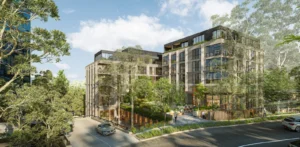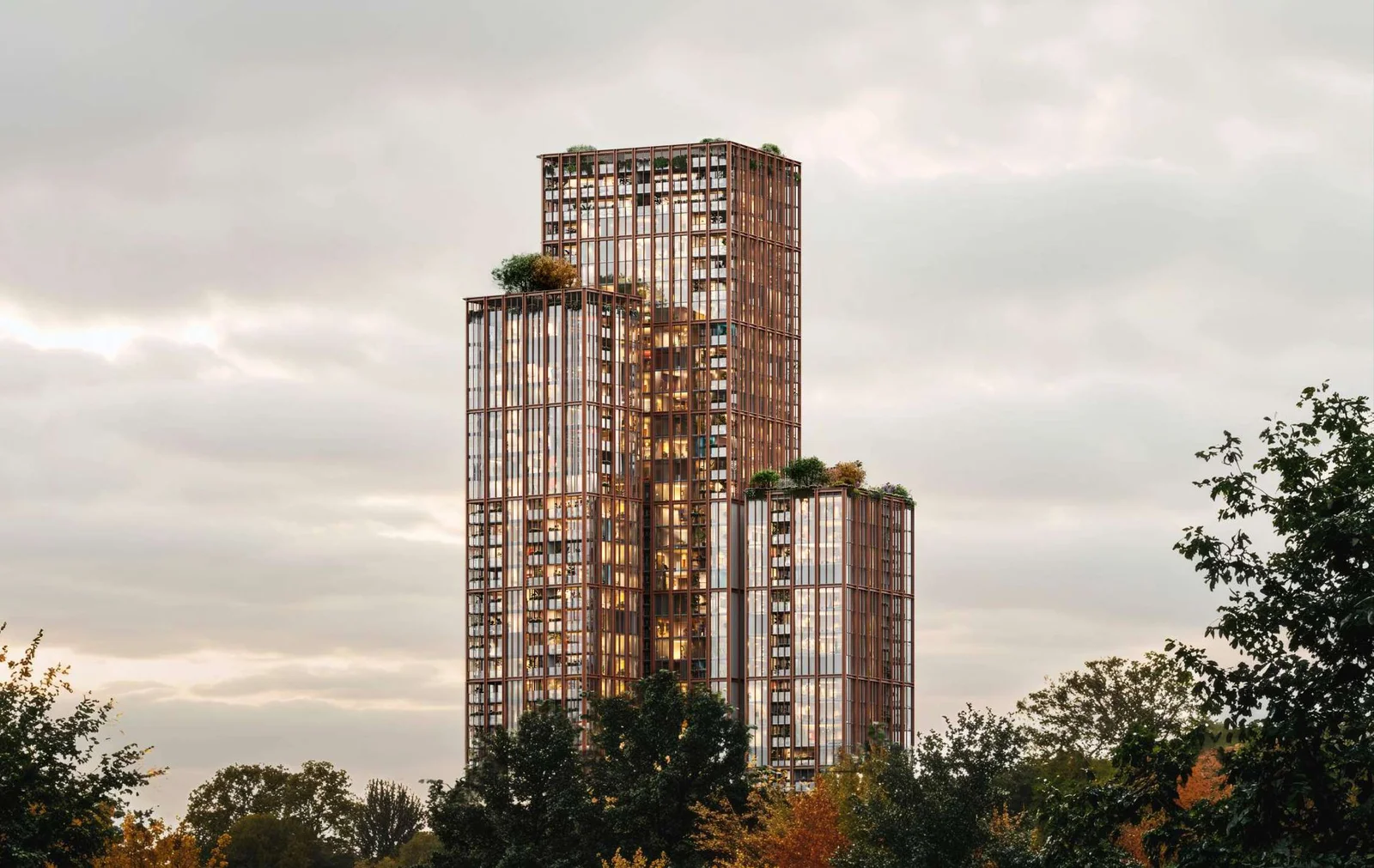
Campsie is emerging as a key battleground in Sydney’s next wave of metro-led densification, with a 39-storey shop-top housing proposal now on public exhibition for a 3,843.8 sqm site at 124–128, 132–142 Beamish Street and 16–18 Ninth Avenue.
The State Significant Development application (SSD-88527208) seeks approval for 346 apartments — including 26 affordable dwellings — alongside approximately 7,300 sqm of retail and commercial floor space. With a proposed maximum height of 138 metres and a floor space ratio of 9.63:1 (via a requested 10:1 control), the scheme represents a substantial departure from existing planning controls and Council’s draft masterplan settings.
The proposal is accompanied by a concurrent rezoning through a self-repealing SEPP to amend the Canterbury-Bankstown LEP 2023.
Tower and Podium Plans
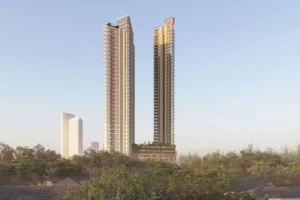
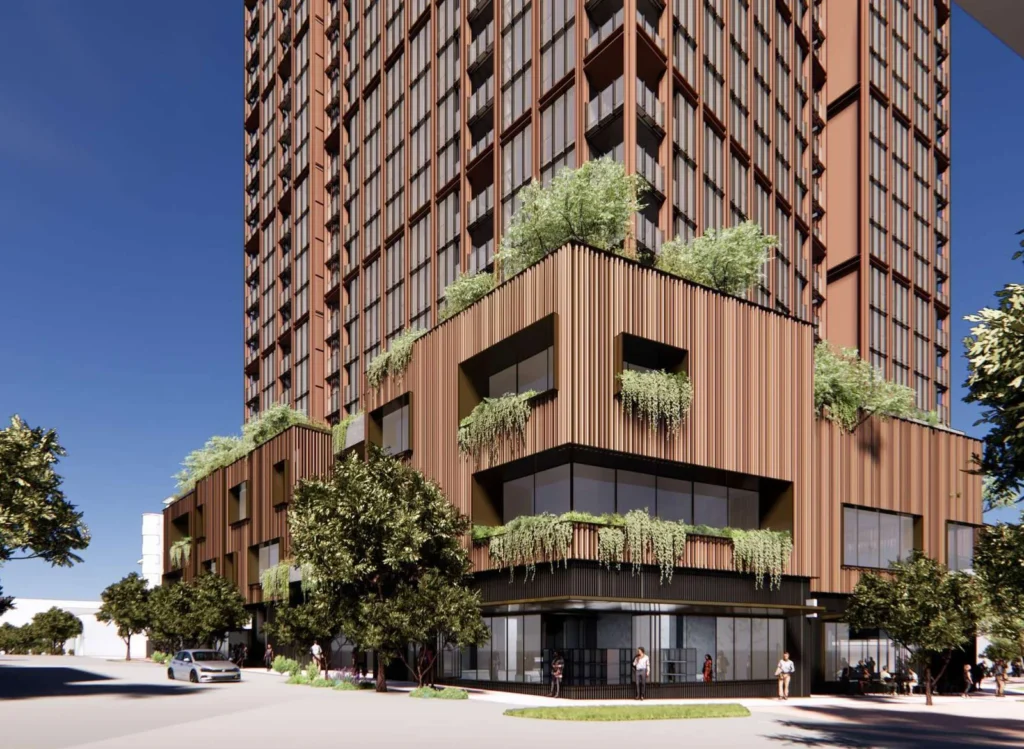
The development comprises three towers of 24, 32 and 39 storeys rising above a three-storey podium and five basement levels.
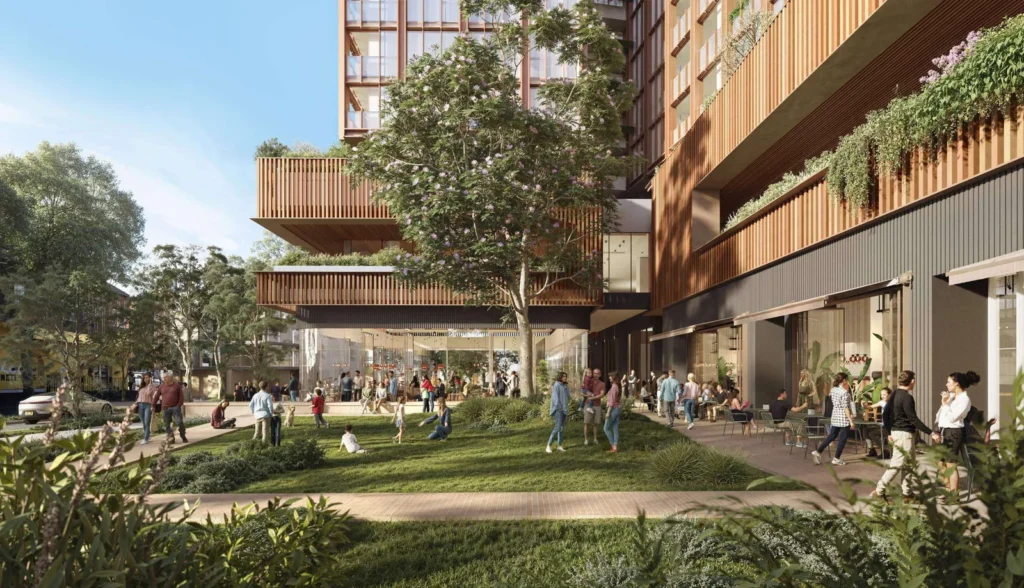
The podium would accommodate four retail tenancies, a flexible food hall, a large commercial tenancy, a high-end restaurant, residential and commercial lobbies, and a publicly accessible pocket park. Residential amenities would include a gymnasium, wellness centre, swimming pool, spa, rooftop garden at level 24, and a sky garden at level 32.
The residential component delivers 346 apartments, with 6 per cent allocated as affordable housing. The affordable dwellings are supported by a letter from Bridge Housing Limited, indicating involvement of a registered community housing provider.
Basement levels provide parking and servicing, with separate vehicle access from Ninth Avenue for residents and Campsie Street for service vehicles.
Central Location and Timing
The site sits approximately 200 metres north of Campsie Station, which is being upgraded as part of the Sydney Metro Southwest conversion. The proponent positions the scheme as a transit-oriented response aligned with the National Housing Accord and NSW Government housing supply targets.
Campsie is identified as a Strategic Centre under regional planning frameworks, with capacity for substantial housing and employment growth. The site is currently vacant following demolition of earlier buildings, creating what the applicant describes as an opportunity for urban renewal within the town centre core.
A Planning Framework in Flux
The application follows a March 2025 declaration by the Minister for Planning and Public Spaces that the proposal qualifies as State Significant Development, following a recommendation from the Housing Delivery Authority.
However, the proposal lands amid an evolving local planning framework.
Canterbury-Bankstown Council’s exhibited Campsie Town Centre Planning Proposal (PP-2024-2261) seeks to implement the Campsie Master Plan through more moderate uplift controls, including:
- Rezoning to MU1 Mixed Use
- A maximum building height of 67 metres
- An FSR of 1.8:1
- A 3 per cent affordable housing contribution
By comparison, the current SSD seeks more than double the proposed height and over five times the draft FSR control.
The divergence between the State-led proposal and Council’s exhibited framework is likely to be a central issue during assessment.
Debate Over Scale and Economics
A key element of the application is its economic viability argument.
The proponent’s Economic Impact Assessment concludes that redevelopment under the draft 1.8:1 FSR control — or even a 6.37:1 scenario under Housing SEPP uplift — would not meet land value benchmarks or absorb fixed costs associated with site preparation, podium construction and public domain works.
According to the assessment, an FSR of 9.63:1 represents the minimum density required to enable viable redevelopment while delivering public benefits and affordable housing.
The project carries an estimated development cost of $305.25 million. The report forecasts approximately 1,014 construction jobs and around 155 ongoing operational roles across retail, hospitality, medical services and building management.
Project Team
- Developer: Arada Australia
- Planning: Mecone
- Architecture: Woods Bagot
- Urban Design: Hatch
- Landscape: McGregor Coxall
- Economic Impact: Hadron Group
- Traffic: TTPP Transport Planning
- Heritage: Urbis
- ESD/BASIX: Windtech
- Social Impact: Hadron Group
For more information, search the application number (SSD-88527208) on the NSW Department of Planning, Housing and Infrastructure’s website.