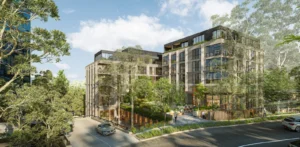
A major new residential development is proposed for 23-31 Dover Road, Rose Bay, with an estimated cost of $86.6 million. The project aims to deliver a significant boost to local housing supply, including a dedicated affordable housing component, under the NSW Government’s recently introduced Low and Mid-Rise (LMR) and In-fill Affordable Housing (IAH) policies. Lodged as a State Significant Development Application (SSDA), the proposal is positioned to leverage both state and federal housing targets. It represents a substantial urban intervention adjacent to the Rose Bay town centre.
Project Overview
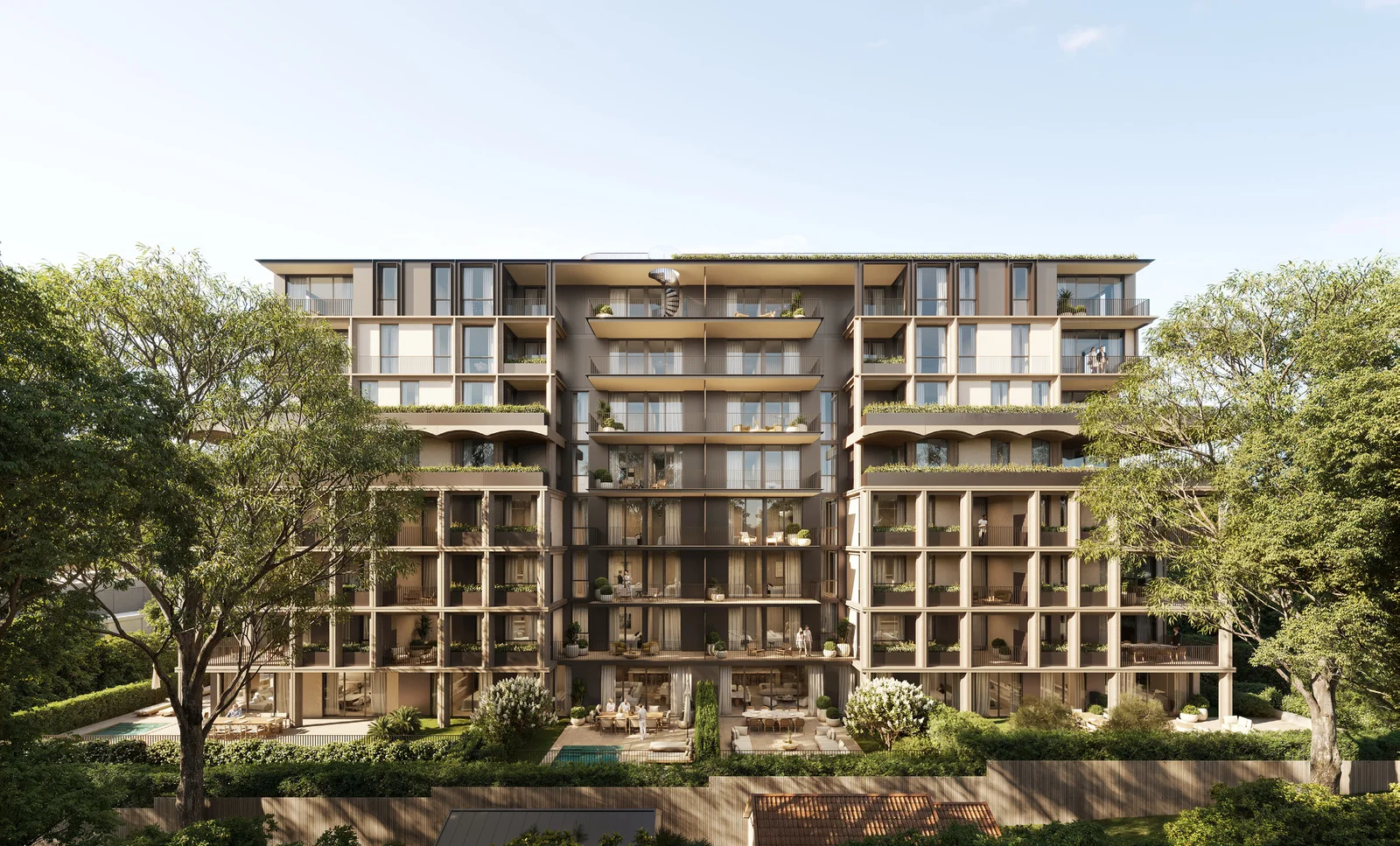
The application seeks approval for the demolition of five existing dwellings and the construction of an eight-storey residential flat building comprising 49 apartments. Of these, 11 will be affordable housing units managed by Bridge Housing for a minimum of 15 years. The development includes two basement levels with 60 resident and six visitor car spaces, 54 bicycle spaces, and seven motorbike spaces. Communal open space of 664sqm is provided, alongside extensive landscaping, including 19 new trees and over 4,400 plantings. The building will feature a rooftop communal terrace and an impervious wall along Dover Road to mitigate flood risk. To accommodate the basement, the project will remove 27 existing trees and excavate to a depth of up to 9.38 metres.
Strategic and Policy Context
Recent state policy reforms targeting housing supply and affordability have directly shaped the proposal. The site qualifies for uplift under both the LMR and IAH provisions of the State Environmental Planning Policy (Housing) 2021. These provisions allow for increased height and floor space in exchange for affordable housing delivery. The EIS contends that the project will help Woollahra Council meet its assigned target of 1,900 new dwellings by 2029, as set under the National Housing Accord. Furthermore, the development aligns with the Greater Sydney Region Plan, the Eastern City District Plan, and Woollahra’s Local Strategic Planning Statement. Each of these policies prioritises diverse, well-located housing and urban renewal in accessible centres.
Design and Architectural Intent
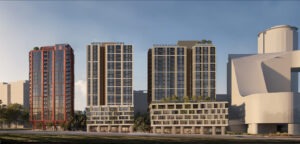
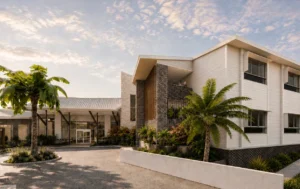
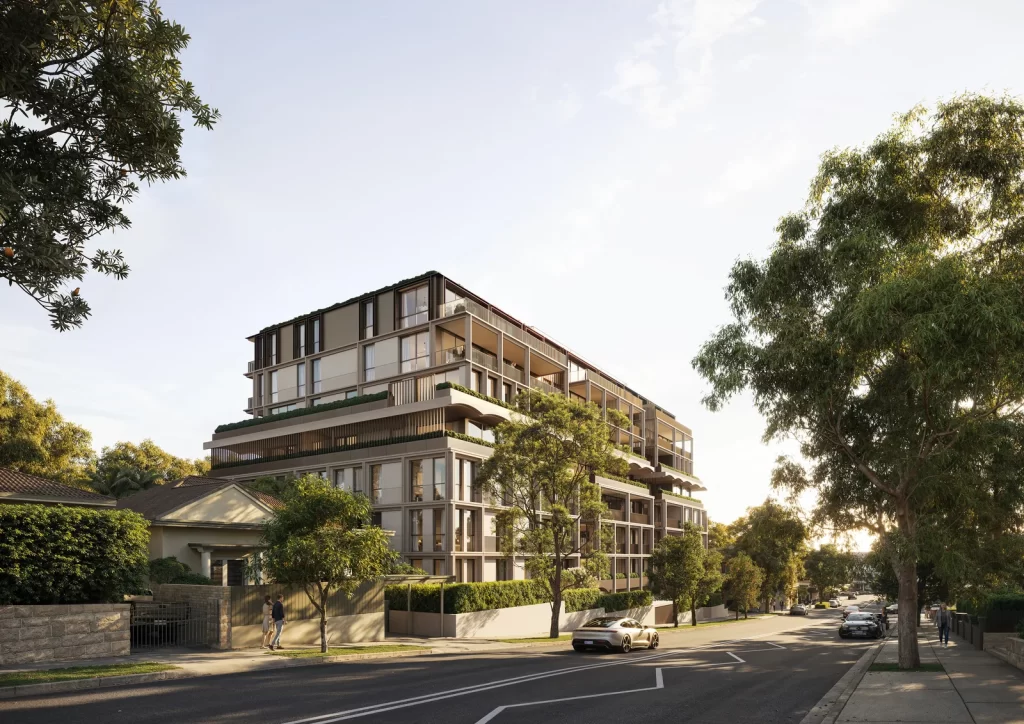
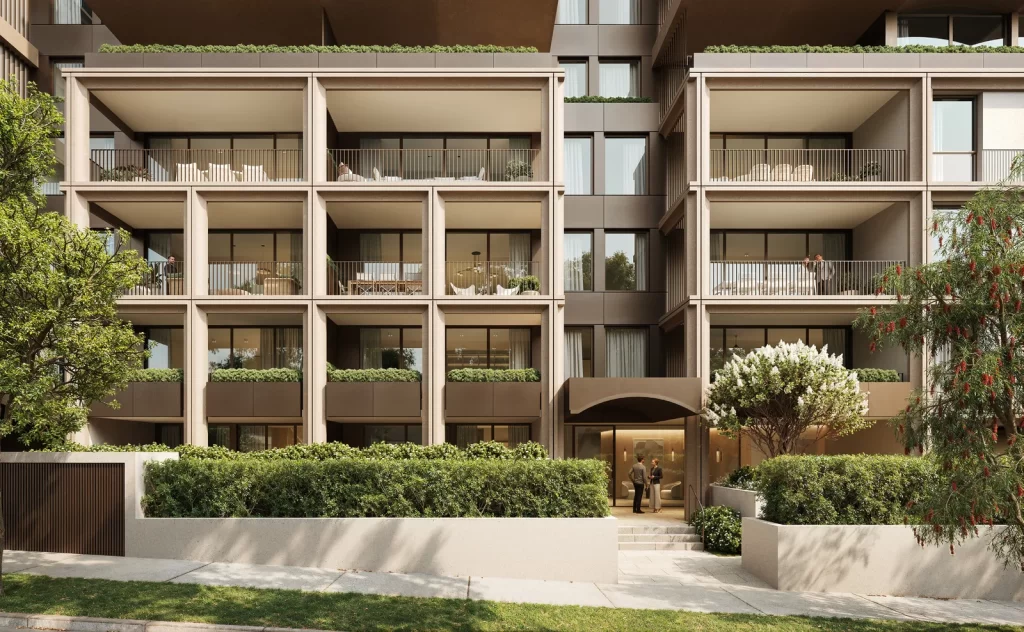
MHN Design Union has prepared a contemporary architectural scheme that references local heritage elements such as the Rose Bay Hotel’s colonnades and awnings. The eight-level building is articulated with a structural grid of slender off-white frames, stepped and recessed to create landscaped balconies and break down the massing. The podium is defined by a sandstone-coloured wall and generous verge planting, while bronze-toned infill panels and canopies add warmth and texture. Upper-level setbacks reduce visual bulk and provide communal rooftop terraces with panoramic views.
The landscape strategy prioritises deep soil planting, privacy, and integration of native species, with 9.8% of the site dedicated to deep soil zones and a total of 4,461 new plantings. Internally, the building is organised around two central lift cores, offering a mix of apartment sizes and equitable access to communal spaces for all residents, including those in affordable housing.
Community and Stakeholder Response
Community and stakeholder engagement involved traditional custodians, adjoining landowners, and relevant agencies. The EIS summarises feedback themes as including concerns about building height, traffic impacts, tree removal, and neighbourhood character. In response, the applicant reports that the design was refined to address these issues. Measures include the retention of street trees, increased landscaping, and strategies to manage construction and operational impacts. Engagement with local Aboriginal parties also informed the cultural heritage assessment and landscape approach.
Impacts and Mitigation
The EIS identifies several key impacts and corresponding mitigation measures. The removal of 27 trees will be offset by the planting of 19 new trees, 21 palms, and extensive shrubbery. Flood risk is addressed through the construction of an impervious wall along Dover Road. Potential contamination, including asbestos, will be managed through a hazardous materials survey and clearance procedures prior to demolition.
The project’s traffic and parking impacts are assessed as manageable, with sufficient on-site parking and access arrangements. Noise, vibration, and construction impacts will be managed through a detailed Construction Traffic Management Plan and adherence to standard construction hours. The EIS argues that the minor height variation (4.8% above the control, limited to the lift overrun) will not result in adverse overshadowing or visual impacts, given the building’s setbacks and design.
Statutory Pathway and Next Steps
The proposal qualifies as State Significant Development under the Planning Systems SEPP, with an estimated development cost exceeding $75 million and a residential component that meets the affordable housing requirements. The Minister for Planning is the consent authority. The application is supported by a comprehensive suite of technical reports, including design, heritage, traffic, environmental, and social impact assessments.
Next steps involve public exhibition, further agency and community consultation, and assessment by the Department of Planning, Housing and Infrastructure before a determination is made.
Project Team
- Developer: Dover Street (Rose Bay) Developments Pty Ltd
- Planning: Urbis
- Architecture: MHN Design Union
- Landscape: Wyer & Co
- Community Engagement: Brilliant Logic
- Heritage: Virtus Heritage, Weir Phillips Heritage
- Engineering: Morrow Geotechnics, NDY
- Traffic: PDC Consultants
- Arboriculture: Martin Peacock Tree Care
- ESD: IGS
- Waste: MRA Consulting Group
- Accessibility: Nest Consulting Group
- Cost Planning: WT Partnership
- Community Housing Provider: Bridge Housing
For more information, search the application number (SSD-86017721) on the NSW Department of Planning, Housing and Infrastructure’s website.