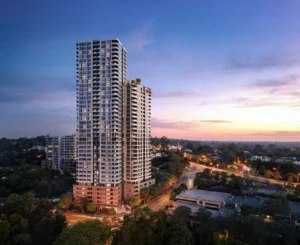
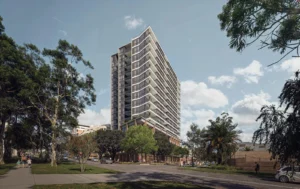
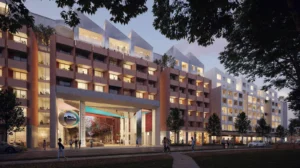
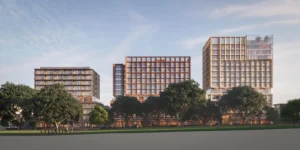
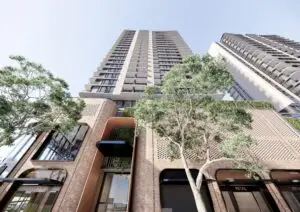
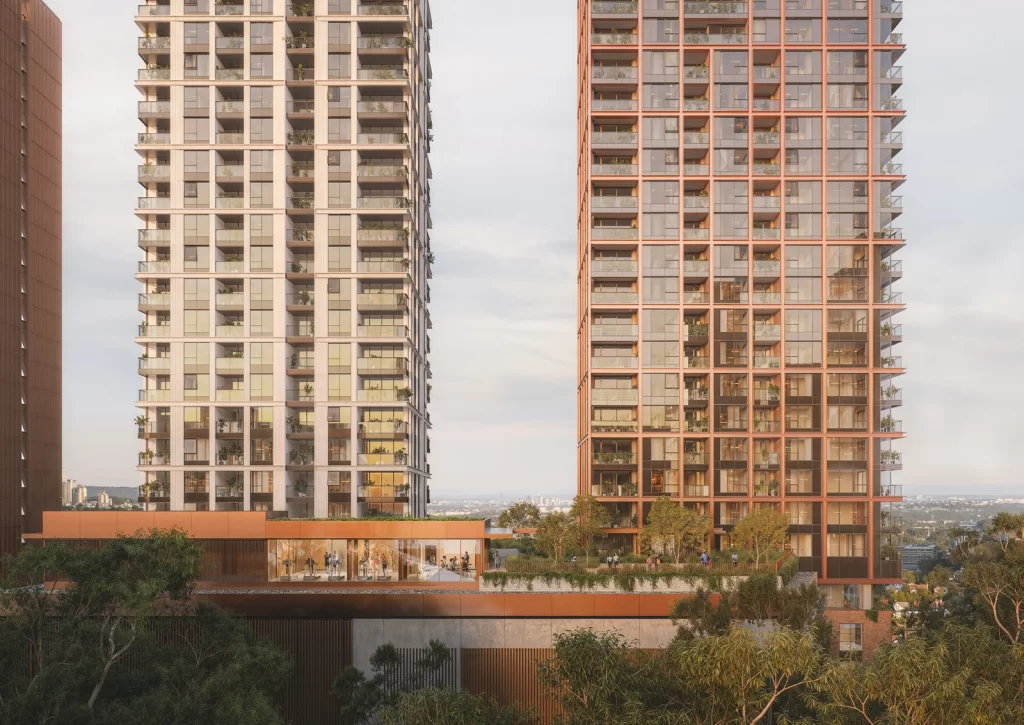
Plans are on exhibition for a major residential development above Sydney’s new Waterloo Metro Station. The proposal would see two towers of 24 and 21 storeys rise above a mixed-use podium on the corner of Cope and Raglan streets.
The application, lodged as a State Significant Development (SSD), seeks approval for 314 apartments—including 39 affordable units—and 4,915 square metres of commercial office space. A new public pedestrian link and upgraded landscaping also form part of the proposal.
The site, part of the broader Waterloo Metro Quarter (WMQ), sits directly above the recently opened Metro station and forms the northernmost section of the over-station precinct.
Commercial Ambitions Scaled Back
Originally approved in 2019 for a mix of office and residential buildings, the northern precinct was later amended in 2021 to accommodate a large commercial office tower. However, as demand for city-fringe office space fell post-pandemic, plans for the precinct were reconsidered.
With limited commercial leasing interest despite active marketing since 2020, the developer has now proposed replacing the approved office tower with two residential buildings. The proposal aims to respond to shifting market conditions and growing demand for housing in the inner city.
The revised application aligns with the NSW Government’s focus on housing supply near transport. It also contributes to National Housing Accord targets, which call for 1.2 million new dwellings nationwide between 2024 and 2029—including 377,000 in NSW. The City of Sydney is forecast to fall 4,900 homes short of its share.
A New Over-Station Precinct
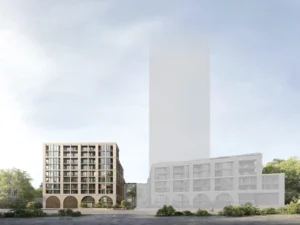
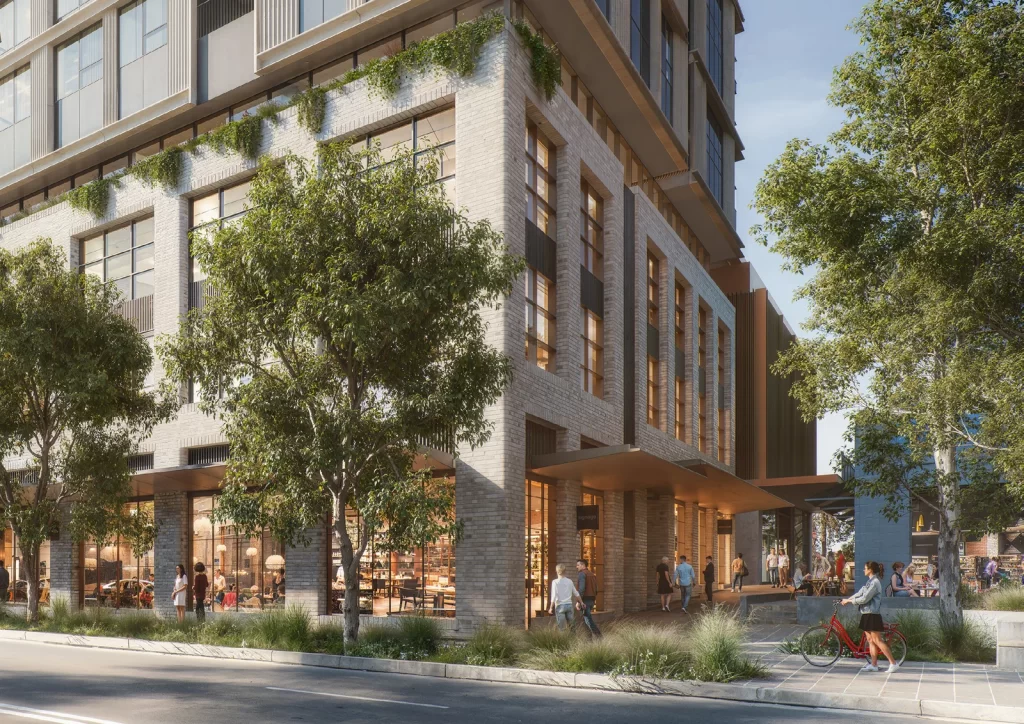
The proposed buildings will be constructed above a four-storey podium that wraps around the Metro station. Designed by Woods Bagot, the towers are setback above the podium to reduce visual bulk and maintain solar access at street level.
The podium will include retail on the ground floor, commercial offices on levels 2 to 4, and essential infrastructure including loading docks, a substation, and building services. Access to basement parking and servicing areas will be via Cope Street and Botany Road.
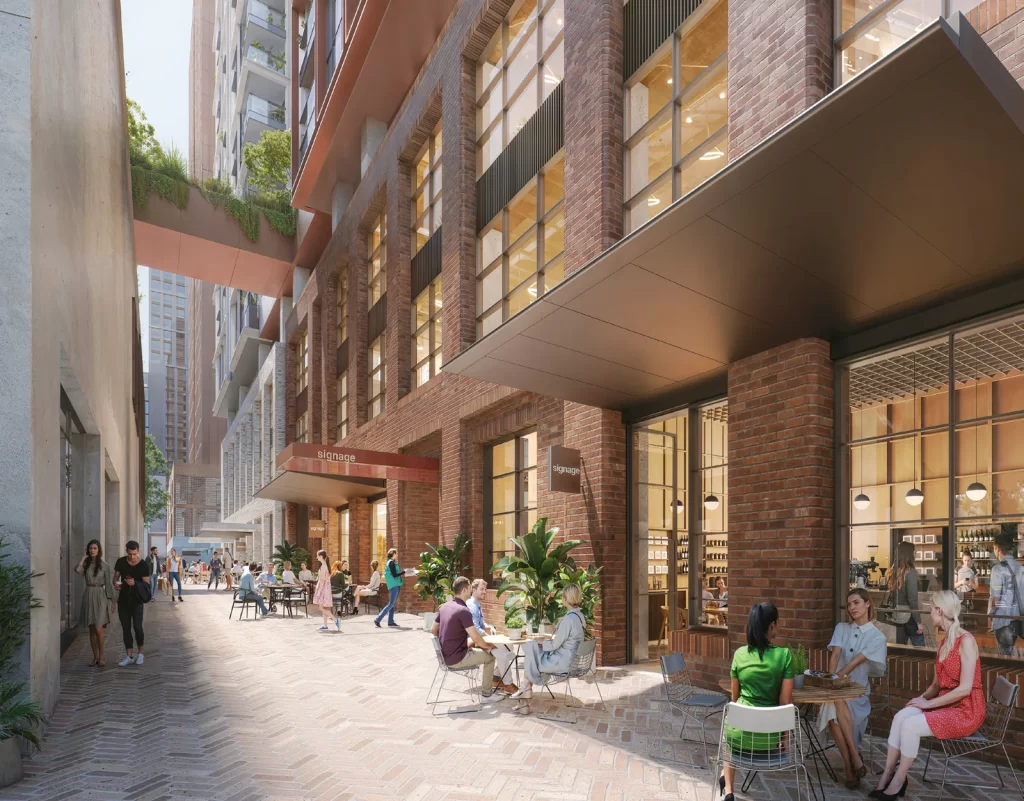
Above the podium, communal open space will be provided on both the Metro station roof and the Level 4 podium roof, connected by a bridge spanning a landscaped pedestrian corridor known as Raglan Walk.
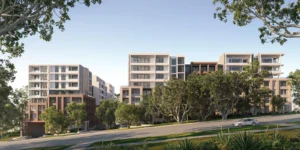
The design references Waterloo’s industrial past, using brick textures and articulated façades to create a contextual yet contemporary identity. The towers aim to provide a “landmark urban form” without dominating surrounding streetscapes.
Pedestrian Link and Public Realm Strategy
A key feature of the proposal is a landscaped pedestrian connection running north–south through the site. This open-air laneway, dubbed Raglan Walk, connects Raglan Street to the central precinct and enhances permeability across the broader WMQ site.
The development also proposes extensive public domain upgrades including new street tree plantings, widened footpaths, and building setbacks to increase light penetration and visual openness at ground level.
Street-level activation will be delivered via retail frontages along Cope and Raglan streets, creating a more walkable, mixed-use environment integrated with the station.
Design Review and Evolution
The design has evolved through four reviews by the State Design Review Panel (SDRP), following Sydney Metro’s updated Design Excellence Strategy. Feedback from the SDRP influenced key aspects of the proposal, including tower placement, façade treatment, and public realm design.
The previous requirement for a competitive design process was waived under Sydney LEP 2012 due to the site’s participation in the Sydney Metro Design Excellence Strategy.
Notably, the current detailed design is consistent with a concurrently lodged Second Amending Concept DA. This concept amendment—lodged alongside the northern and central precinct detailed DAs—updates the planning framework to reflect a shift away from commercial office use in the north and toward residential and co-living uses across the precinct.
If the new detailed applications are approved, previously granted consents will be surrendered, and the amended concept plan will take precedence.
Community Input Shapes the Final Scheme
During preparation of the application, the project team engaged with neighbouring landowners, tenants, and public agencies. Feedback focused on integration with the Metro station, pedestrian access, public amenity, and building scale.
In response, the design was refined to improve pedestrian connectivity, enhance ground-floor activation, and increase landscape treatments. Building massing and setbacks were also adjusted to protect sunlight access to public spaces and minimise overlooking.
Community input will continue to shape the project during the public exhibition period, which remains open for formal submissions.
Managing Environmental and Social Impacts
The development proposes several mitigation measures to reduce its impact on the local environment and urban amenity.
Shadow studies show limited additional overshadowing to nearby parks, with full compliance to the Apartment Design Guide’s solar access benchmarks. Wind conditions have been modelled and addressed through landscape buffers and podium shaping.
Car parking is limited to encourage Metro use, with improved cycling access and end-of-trip facilities. Sustainability features include energy-efficient systems, water-sensitive urban design, and integration of green infrastructure.
Social benefits are also highlighted. These include affordable housing delivery, new public spaces, and increased housing choice in a high-accessibility location.
Next Steps in the Planning Process
Because the proposal meets State Significant Development thresholds—due to its size and proximity to rail infrastructure—it is being assessed by the NSW Department of Planning, Housing and Infrastructure.
The application is now on public exhibition. After submissions close, the applicant must respond to key issues raised. A final decision will then be made by the department.
If approved, this would mark a major step in the transformation of Waterloo Metro Quarter into a dense, transit-oriented urban precinct.
Project Team
- Developer: WL Developer Pty Ltd
- Planning and EIS: Urbis
- Architecture: Woods Bagot
- Community Engagement: Ethos Urban
For more information, search the application number SSD-79307758 on the NSW Department of Planning, Housing and Infrastructure website.