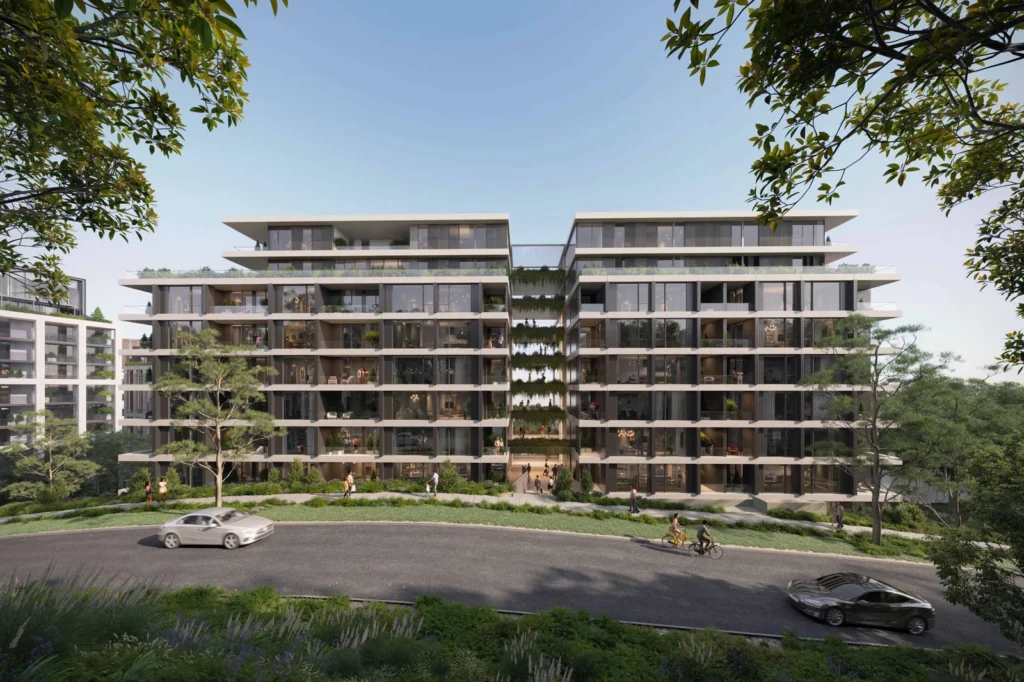
The State Significant Development application for 2–4 Larkin Street and 1–5 Pockley Avenue, Roseville has been approved with conditions by the Deputy Secretary, Development Assessment and Sustainability, under delegation from the NSW Minister for Planning.
The approval paves the way for a 10-storey residential development within 250 metres of Roseville Station, delivering a mix of market and affordable housing under the NSW Government’s Transport Oriented Development (TOD) and in-fill affordable housing reforms.
Project Overview
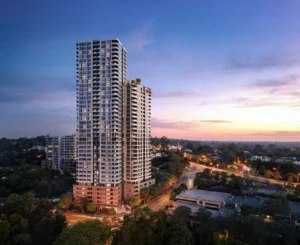
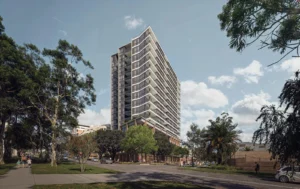
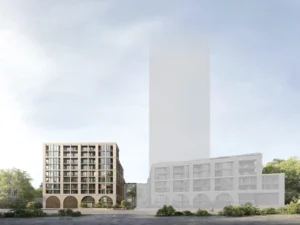
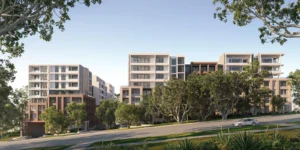
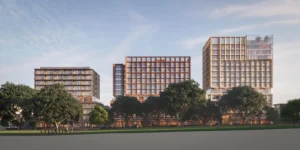
The approved scheme comprises two 10-storey residential flat buildings containing 111 apartments, including 81 market dwellings and 30 affordable homes.
The project provides 11,543sqm of gross floor area, with 15 per cent dedicated to affordable housing. Of the affordable component, 26 dwellings will be managed by Bridge Housing for a minimum of 15 years, while four will be managed in perpetuity.
The development includes three basement levels accommodating 151 car spaces and 119 bicycle spaces. It also provides 890sqm of communal open space.
The 3,551.8sqm site sits within the Roseville TOD catchment and is surrounded by other residential proposals at various stages of assessment. Construction is expected to generate approximately 150 jobs.
Strategic and Policy Context
The proposal leveraged recent state planning reforms designed to accelerate housing supply near public transport.
Specifically, the project utilised provisions under the Housing SEPP relating to in-fill affordable housing and the “saved” Transport Oriented Development controls. These mechanisms allow additional height and floor space where affordable housing is provided within walking distance of rail infrastructure.
Although Ku-ring-gai Council’s updated planning controls for the precinct have since been gazetted, the site retained access to the TOD framework due to the timing of the application.
In its assessment, the Department concluded the proposal aligns with state and national housing targets. It also found the project supports the intended evolution of Roseville towards higher-density housing around the station and remains permissible under the prevailing statutory framework.
Design and Architectural Response
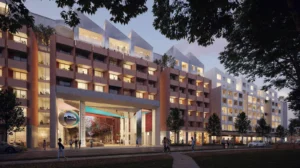
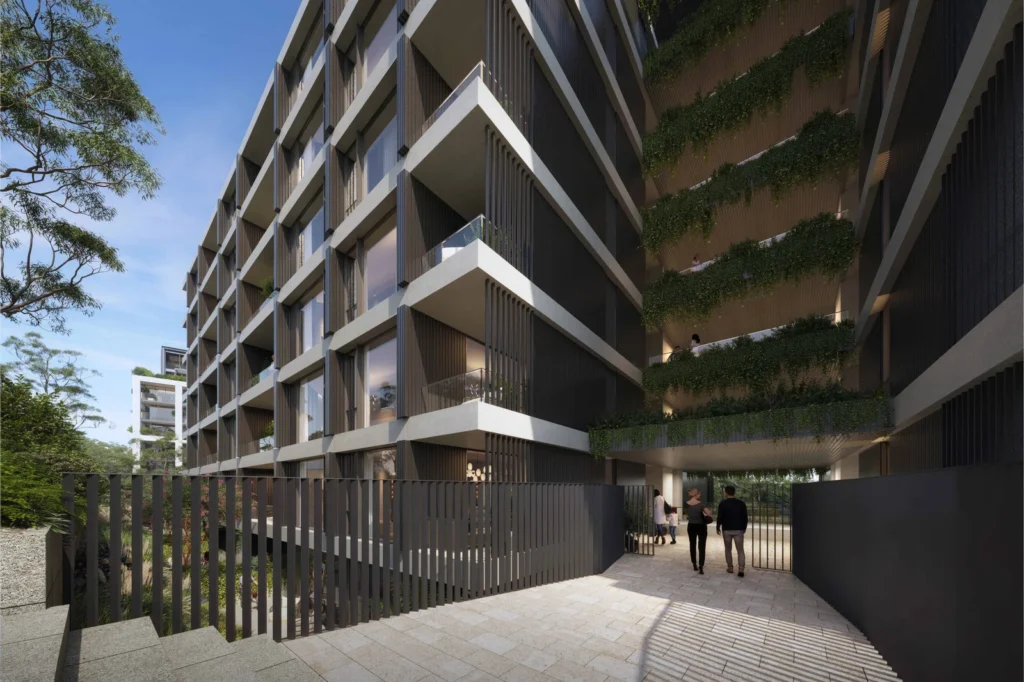
The final scheme separates the built form into two towers connected by a skybridge. This approach increases visual permeability through the site and improves setbacks to neighbouring properties.
Following review by the State Design Review Panel, the design was amended to increase the affordable housing GFA and improve communal open space. The applicant also introduced weather protection louvres and enhanced pedestrian connections.
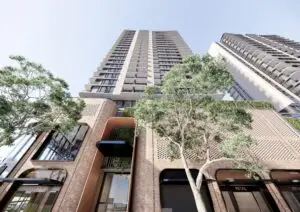
The Department determined the development achieves a high standard of design quality. It cited durable materials, active ground-level interfaces and a landscape strategy that responds to the site’s steep crossfall.
Community and Agency Response
Community feedback was largely opposed. Of 109 public submissions, 101 objected to the proposal.
Key concerns included traffic and parking impacts, bushfire risk, tree removal, height and density, and compatibility with local character.
Ku-ring-gai Council objected to the development, arguing it presented excessive height and density, created overshadowing impacts, and conflicted with its updated planning controls and desired streetscape character. Council also raised concerns regarding setbacks, landscaping and the amenity of some ground-floor apartments.
However, state agencies including Transport for NSW and Heritage NSW raised no objections, subject to standard conditions. Three submissions supported the proposal, citing its housing mix and design approach.
Assessment Findings
The Department found the proposal complies with the maximum floor space ratio of 3.25:1.
Height exceedances were limited to rooftop elements and minor portions of the upper storeys. The Department accepted the Clause 4.6 variation, concluding the exceedance responds to site topography and does not result in unacceptable amenity impacts.
Although some ground-floor apartments sit below street level, the Department accepted the applicant’s justification. These apartments exceed minimum size standards and are not part of the affordable housing allocation.
Solar access and overshadowing impacts were considered acceptable, with only minor departures from Apartment Design Guide criteria.
Traffic impacts were assessed as manageable. The Department noted cumulative impacts would be addressed through future infrastructure upgrades.
Stormwater management, landscaping and biodiversity impacts were also deemed acceptable, subject to detailed conditions of consent.
Determination and Conditions
The Department recommended approval subject to conditions, finding the proposal consistent with state housing priorities and in the public interest.
Key considerations included strategic alignment with TOD and affordable housing policy, compliance with principal planning controls, and the acceptability of environmental and amenity impacts.
Conditions of consent require adherence to approved materials and finishes, implementation of a Green Travel Plan, detailed stormwater management, and restrictions on tree removal outside the site.
Project Team
- Developer: The Trustee for Aqualand Prestige 1 Unit Trust
- Community Housing Provider: Bridge Housing
- Architect: Woods Bagot
- Planning Consultant: Planning & Co
- Landscape Architect: Ground Ink
- Traffic Engineer: Varga Traffic Planning
- ESD Consultant: Stantec
- Arborist: Naturally Trees
- Geotechnical / Contamination: EI Australia
- Social Impact: Forward Thinking
- Wind Consultant: Windtech
For more information, search the application number (SSD-77829461) on the Department of Planning, Housing and Infrastructure’s website.