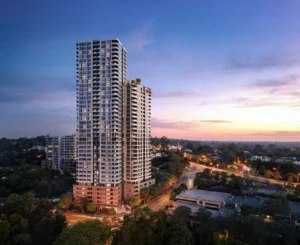
Thirdi Crows Nest Commercial Developments Pty Ltd has submitted a State Significant Development application for a $233.4 million mixed-use project above the Crows Nest Metro Station at 32 Hume Street, Crows Nest. The proposal seeks approval for a major over station development that combines residential, affordable housing, and commercial uses within the North Sydney local government area. This Crows Nest over station development is one of several urban renewal projects reshaping Sydney’s transport precincts.
Proposal Overview
The development involves three towers with a combined Gross Floor Area (GFA) of 44,609 square metres. It includes two Build-to-Rent (BTR) towers and a third tower dedicated to affordable housing. The proposal delivers 474 apartments—418 for BTR and 56 for affordable housing, equating to 15% of the total. Retail premises, a gym, and shared resident facilities are located at ground level, with the towers positioned above a shared podium. The application also includes service upgrades and infrastructure works. This mixed-use development in North Sydney aims to deliver diverse housing types while maximising access to public transport.
Background of the Proposal
The site sits directly above the Crows Nest Metro Station and forms part of the wider Sydney Metro infrastructure corridor. Covering 3,879 square metres, the site is zoned Mixed Use (MU1) under the North Sydney Local Environmental Plan. Its strategic location supports higher-density development in a transit-oriented setting.
Initially approved as a commercial tower under Concept SSD-9579, the site has since been reconsidered. An Amending Concept SSDA (SSD-75662958) has been submitted alongside the detailed application to support a residential-led outcome.
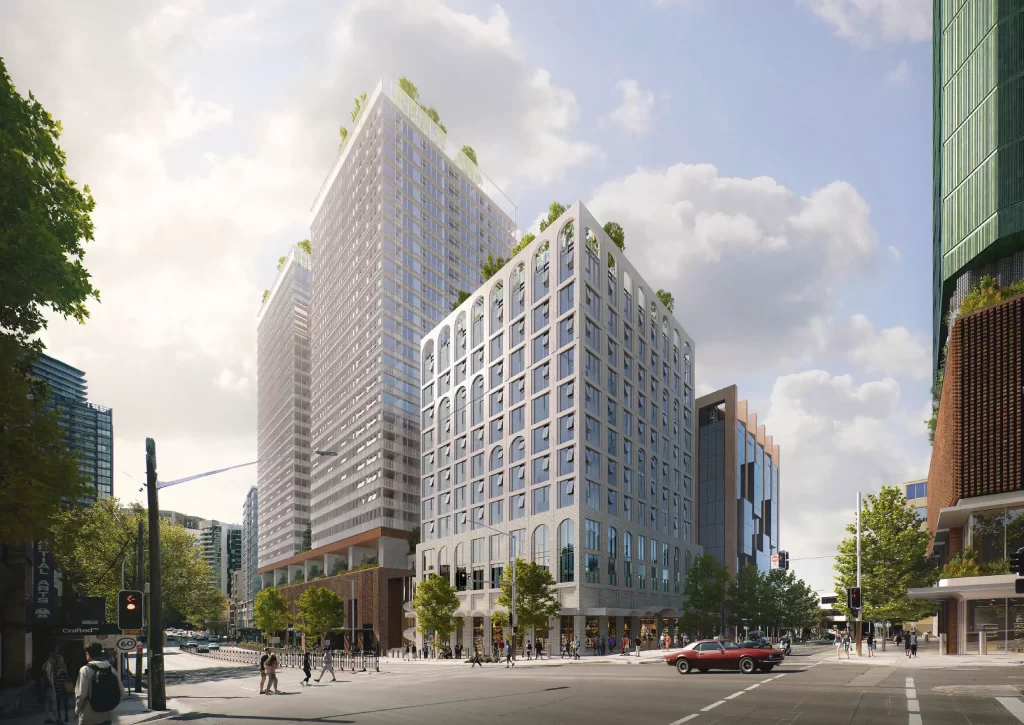
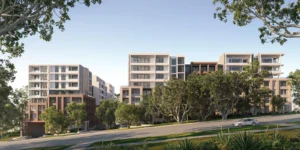
Artist impression by Woods Bagot
Planning Context and Zoning
The amended proposal responds to the Crows Nest Transport Oriented Development (TOD) rezoning, finalised in November 2024. This policy initiative identifies the precinct as a Tier One Accelerated Precinct, aimed at delivering up to 5,900 new homes and 2,500 jobs. It encourages residential density around metro infrastructure while reducing commercial floor space expectations.
The site retains its MU1 zoning, which permits residential and commercial uses with consent. The amended concept and detailed proposal support these objectives through a mixed-use scheme with 15% affordable housing and compliance with the 1:1 non-residential FSR requirement. The site’s integration with the metro station and proximity to services position it for residential intensification. This aligns with broader objectives for urban densification near public transport in Sydney.
Market and Demand Shifts
The revised scheme also responds to broader market changes. Commercial office demand in the area has weakened significantly since the COVID-19 pandemic, with vacancy rates nearing 30%. By contrast, demand for secure rental housing and affordable accommodation has grown. These shifts have prompted a re-evaluation of the site’s commercial viability in favour of a residential use supported by existing infrastructure.
Rationale for Changes to the Original Concept
Several factors underpin the proposal’s evolution from its original concept:
- Economic and Market Conditions: The sustained decline in office demand and high vacancy rates in Crows Nest and St Leonards have made a commercial scheme unfeasible.
- Strategic Planning Alignment: The TOD rezoning promotes residential development in proximity to metro stations, with targets for new homes and reduced commercial floor space.
- Housing Supply Prioritisation: The proposal supports housing diversity through Build-to-Rent and affordable housing provisions, aligning with broader housing supply goals.
- Design Efficiency and Amenity: A shift from a single commercial block to three residential towers improves daylight access, view sharing, and urban integration.
- Policy Response: The application supports planning objectives under the National Housing Accord and NSW Government housing supply strategies.
These considerations collectively support the transition to a mixed-use, residential-led development above the metro station.
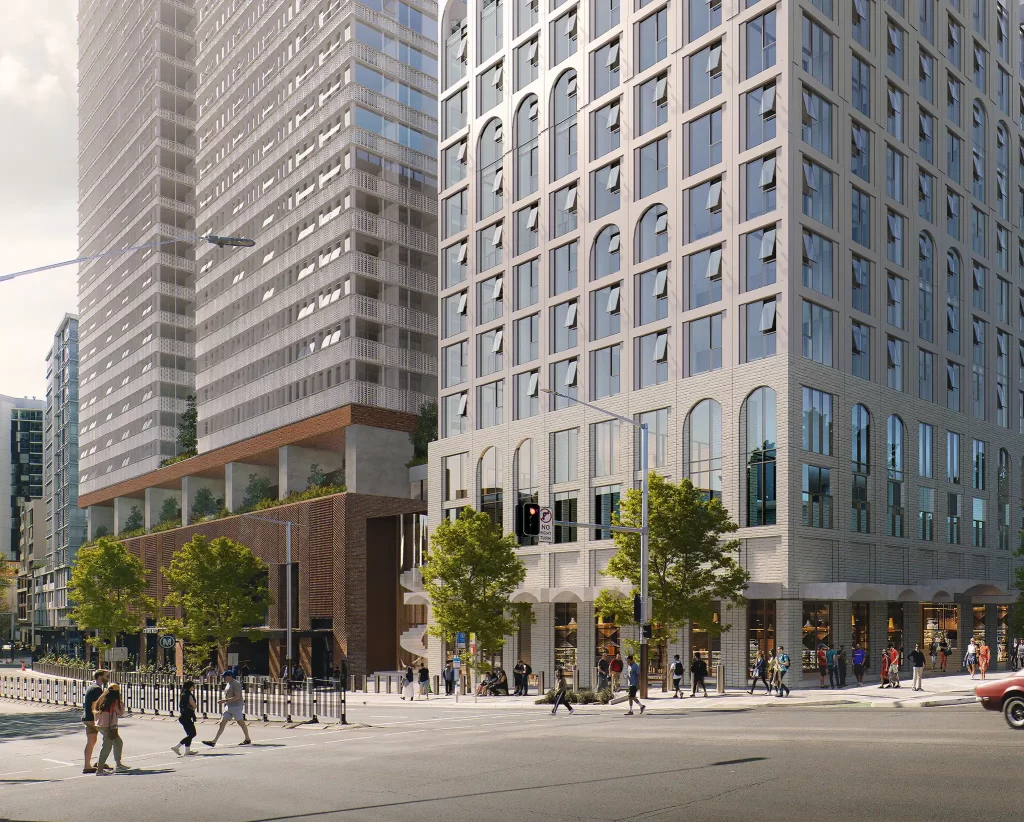
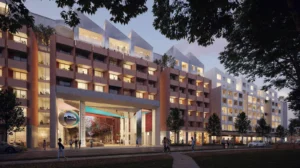
Artist impression by Woods Bagot
Design
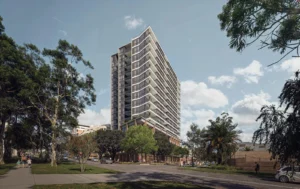
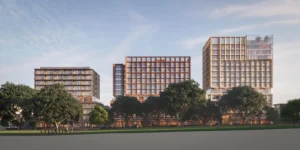
The proposal comprises three towers positioned above a shared podium directly connected to the operational Crows Nest Metro Station. This integration, made possible through earlier CSSI approvals, allows for direct access to the station and surrounding transport links.
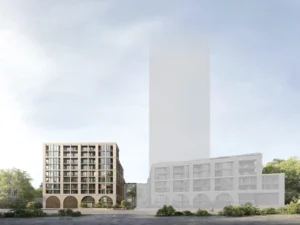
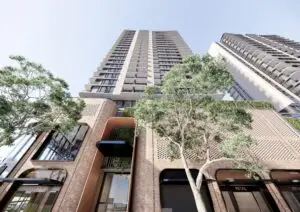
The design, prepared by Woods Bagot, follows the parameters set by the amended concept approval. The towers vary in height and use a combination of articulated façades, stepped forms, and material variation to manage bulk and improve visual outcomes. The configuration supports solar access, view sharing, and passive environmental performance.
Arcadia’s landscape design includes deep soil zones, rooftop communal areas, and enhancements to the public domain. Sustainability features include BASIX and NatHERS compliance (average 7.1 stars), energy-efficient systems, and rooftop solar infrastructure. The buildings are fully electric and incorporate strategies for reduced water use and carbon emissions. These features contribute to a low-carbon residential development model.
Crime Prevention Through Environmental Design (CPTED) principles are addressed through clear sightlines, passive surveillance, and well-defined public interfaces.
Project Team
- Developer: Thirdi Crows Nest Commercial Developments Pty Ltd
- Architect: Woods Bagot
- Planning Consultant: Gyde Consulting
- Landscape Architect: Arcadia
- Traffic & Transport Consultant: Transport Strategies Alliance Pty Ltd
- Acoustic Consultant: Pulse White Noise Acoustics
- Sustainability Consultant: Credwell Energy Pty Ltd
- Structural Engineer: Robert Bird Group
- Civil Engineer: S&G Consultants
- Heritage Consultant: City Plan Heritage Pty Ltd
- Wind and Environmental Studies: RWDI Australia Pty Ltd
- Accessibility Consultant: Steve Watson & Partners
- Fire & Risk Advisor: Scientific Fire Services
- Visual Impact Assessment: RPS and Virtual Ideas
For more information on SSD-75662958 (Amending Concept SSDA) and SSD-75660711 (Detailed SSDA), visit the Department of Planning, Housing and Infrastructure at: